

 Health & Beauty


.png) Art & Painting
Art & Painting Hot Deals

.png)



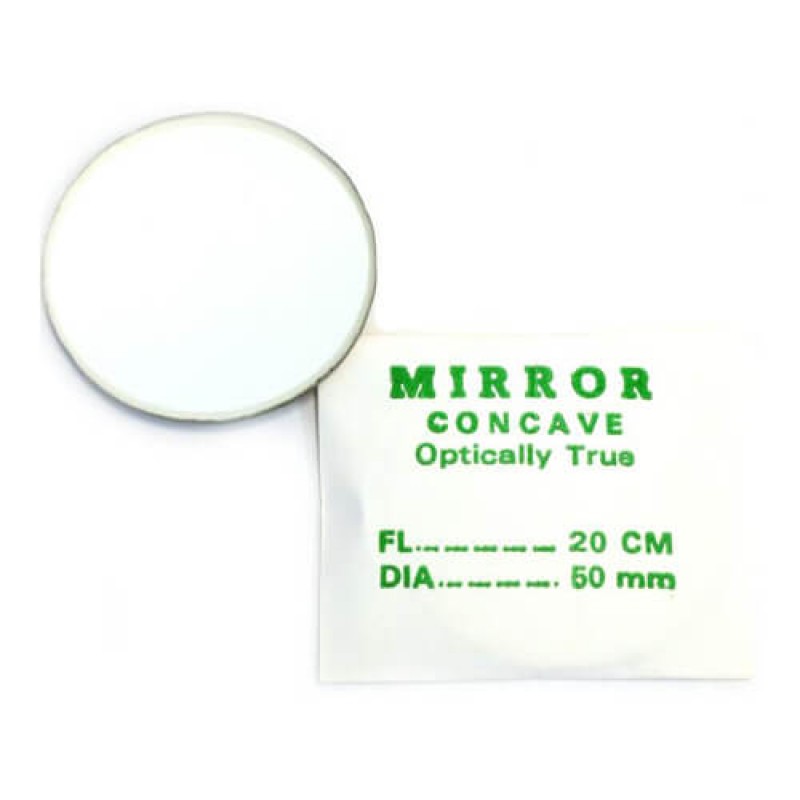
Concave Optical Mirror 50 mm for Optical Experiments
A Concave Optical Mirror 50 mm is a specific type of spherical mirror characterized by a reflective inner surface, meaning the center of the mirror curves inward, away from the observer . This design causes light rays that strike the mirror to converge, or meet, at a single focal point in front of the reflecting surface. The 50 mm specification refers to the approximate diameter of the mirror's aperture, making it a standard, compact size suitable for bench-top experiments in a laboratory setting. It is a fundamental component for demonstrating the laws of reflection, measuring focal lengths, and investigating the formation of both real and virtual images based on an object's position.
Uses :
- Light Convergence: Used to collect parallel light rays and focus them down to a single point, allowing for the precise measurement of the mirror's focal length.
Image Formation: Essential for demonstrating how real, inverted, and diminished (or enlarged) images are formed when the object is placed outside the focal point.
Virtual Magnification: Used to show the formation of virtual, upright, and enlarged images when the object is positioned between the mirror's pole and its focal point.
Ray Tracing: Employed in experiments to visually trace the path of incident and reflected light rays to verify the mathematical principles of geometrical optics.
Spherical Aberration Study: Used to observe the blurring of an image caused by light rays reflecting from the edges of the sphere, which helps in understanding the limitations of spherical mirrors.
If you'd like to know more about this chemical or need any analysis
report regarding this chemical then contact us support@echem.com.bd.















Login To Comment